
Energy Data Management (EDM) is about collecting, organizing, and using energy data to make better decisions.
This data can come from many sources: energy meters, industrial equipment, buildings, weather forecasts, market prices, or renewable assets. When properly managed, it helps organizations:
- use energy more efficiently
- control and reduce costs
- measure and reduce carbon emissions
As energy systems become more complex and increasingly driven by renewables, data has become a strategic resource. It enables organizations to better understand how energy is produced, traded, and consumed, helping them make informed operational and business decisions. These insights support faster and more confident decision-making across the organization.
The digital fuel of the energy transition
Energy Data Management is no longer limited to IT departments. It has become a key driver of the energy transition, supporting efficiency gains, cost optimization, and progress toward carbon neutrality.
In practice, EDM transforms large volumes of raw data into actionable insights.
These insights allow organizations to monitor their energy footprint, anticipate risks, and identify opportunities for improvement.
Industrial companies can optimize production processes, cities can manage building performance across large portfolios, and energy suppliers can design more tailored and flexible offers.
Individual consumers are also increasingly benefiting from data-driven services, gaining better visibility over their consumption and access to personalized energy solutions.
Key concepts: building reliable and actionable energy data
Effective Energy Data Management relies on structured processes that ensure data from multiple sources is reliable and usable for decision-making.
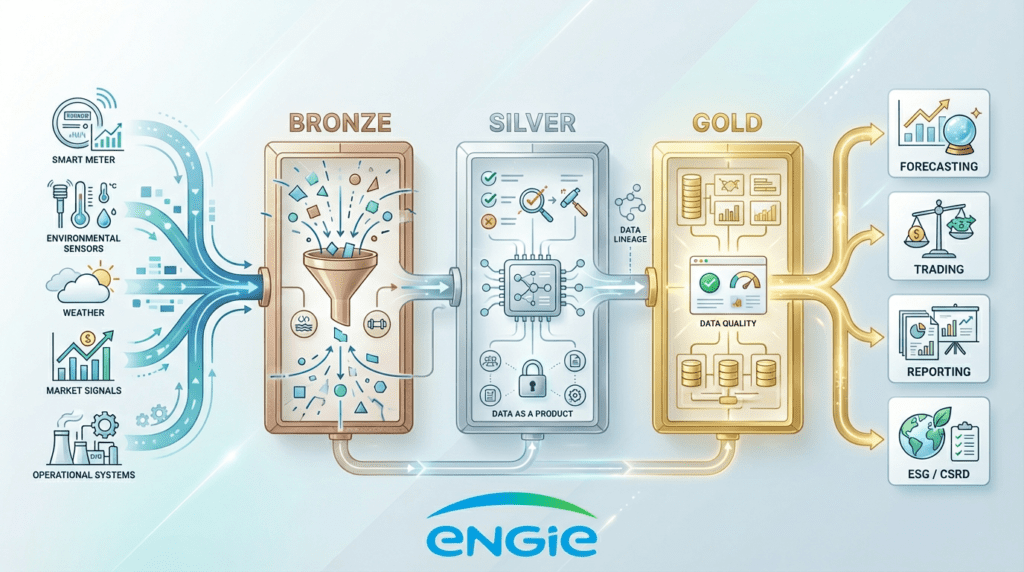
Data as a product
Energy datasets, such as hourly consumption data or weather forecasts, are treated as dedicated products with clear ownership, documentation, and quality standards. This ensures consistency and usability across the organization.
Data quality
Accurate decisions require accurate data. This means:
- detecting errors early
- correcting inconsistencies
- continuously monitoring data accuracy
Without this discipline, forecasting, reporting, or trading decisions can quickly be compromised.
In reality, ensuring high data quality remains an ongoing challenge, as data sources are often fragmented, incomplete, or inconsistent.
Data lineage
Data lineage makes it possible to trace information from its origin to its final use. This transparency strengthens trust, improves accountability, and supports compliance with regulatory requirements, including ESG reporting frameworks such as the Corporate Sustainability Reporting Directive (CSRD).
To make data progressively usable, organizations often rely on a structured architecture, commonly referred to as a medallion architecture:
- Bronze layer: raw data ingestion from meters, sensors, markets, and operational systems
- Silver layer: data cleaning, enrichment, and standardization
- Gold layer: refined datasets ready for business applications such as forecasting, commercial offers, or regulatory reporting
Strong data governance ensures that information remains both operationally valuable and compliant with regulatory expectations.
As Dimitri Tomanos, Chief Data Officer at ENGIE, explains:
“Data volumes are growing rapidly, and our systems must evolve to manage this scale. A few years ago, we handled dozens of assets; today we manage hundreds of thousands.”
Translating data into decarbonization and cost savings
Energy Data Management delivers measurable benefits across industries, public organizations, and commercial sectors.
Operational efficiency and cost optimization
For industrial and private organizations, EDM provides detailed insights into energy-intensive processes. Real-time monitoring helps detect anomalies, improve forecasting accuracy, and optimize procurement strategies, resulting in lower costs and reduced emissions.
In some cases, these optimizations translate into significant financial gains, making data a direct lever for competitiveness.
In the tertiary and public sectors, aggregated data enables performance comparisons across buildings or regions. Cities can identify priority renovation projects, while large retail or office networks can negotiate energy contracts based on precise demand analysis.
Data-driven intelligence also enables innovative commercial offers. In France, ENGIE has introduced a two-hour free electricity offer allowing residential customers to select time slots aligned with their consumption patterns, illustrating how data can empower users.
A catalyst for decarbonization
Decarbonization starts with measurement. Energy Data Management enables organizations to:
- accurately assess emissions
- prioritize investments in renewable energy
- integrate decentralized solutions such as onsite solar or battery storage
High-quality data also supports emerging solutions such as 24/7 carbon-free energy supply, where electricity consumption can be matched with renewable generation in near real time.
While this approach is gaining momentum, its large-scale implementation still depends on market maturity and grid capabilities.
As Dimitri Tomanos notes:
“The world will only decarbonize if clients, grid operators, and suppliers work together. Data enables each actor to understand consumption and take meaningful action.”
How ENGIE uses data to optimize energy systems
ENGIE business plays a key role in connecting energy markets, digital technologies, and customer needs.
By combining real-time data, advanced analytics, and market expertise, ENGIE helps organizations:
- manage energy risks
- optimize asset performance
- accelerate decarbonization strategies
From data to automated energy decisions
For example, battery storage assets can be optimized using continuous data flows. Sensors provide real-time information on charge levels, while market data and forecasting models analyze price signals and trading opportunities.
Based on these inputs, automated systems can determine when energy should be stored or discharged to maximize both economic value and system flexibility.
As Dimitri Tomanos explains:
“Signals can be sent directly to batteries, instructing them to discharge energy at the most favorable market moment. This represents a new era of algorithmic energy management, where real-time models both inform and execute decisions.”
In this context, data becomes the central link between physical assets, market dynamics, and operational strategy.
Looking ahead, Energy Data Management is not a topic for specialists alone. Data concerns every function in the organization, from operations and sales to finance, sustainability, and leadership. Every role contributes to the quality, understanding, and use of data.
Tomorrow, data will be one of ENGIE’s most powerful transformation levers. It will shape how assets are operated, how customers are served, how risks are managed, and how decarbonization commitments are delivered.
By treating data as a shared asset and embedding it into everyday decisions, ENGIE is building a more agile, efficient, and sustainable energy company.