Quality is the New Scarcity: Adjusting Your Carbon Credit Strategy to a Maturing Market
The voluntary carbon market is rapidly consolidating around higher integrity standards, and the window for securing high-integrity credits is narrowing. For corporate buyers still on the sidelines, the question is no longer whether to engage. It is how quickly they can build a credible carbon credit strategy before supply tightens further.
- Article
- Publié le 01/04/2026

A decade that changed everything
Ten years ago, the voluntary carbon market (VCM) was a niche instrument, a peripheral tool for a relatively small cohort of sustainability-minded companies, governed by fragmented standards, inconsistently priced across project types, and largely outside the mainstream of corporate climate strategy. Today, it plays an increasingly strategic role in how large companies are planning to address residual emissions on the path to Net Zero.
Progress has not been linear. The early 2020s brought explosive growth in ambition — and an equally sharp reckoning with quality. Greenwashing scandals, investigative journalism, and academic scrutiny exposed deep weaknesses in several widely-used credit categories: renewable energy projects with questionable additionality, REDD+ forest conservation schemes with overstated baselines, and offset claims that did not hold up under scrutiny. The backlash was real and, in many respects, corrective. It forced a long-overdue reassessment of how integrity is defined, measured, and communicated.
By 2024–2025, a VCM integrity reset was underway, driven by the introduction of the ICVCM’s Core Carbon Principles, the emergence of independent credit-rating agencies, and a decisive shift in buyer expectations. Today, in 2026, the market is increasingly described as having entered a phase of professionalization, with more data, clearer quality standards, and sharper segmentation between high- and low-quality assets.
The core challenge for corporate buyers, however, has not changed. It has intensified. The supply of credits that meet today’s higher integrity and claims readiness thresholds remains limited, even as future demand continues to build toward net-zero milestones. What has changed is how clearly the data now shows the cost of waiting.
The supply crunch is not a future risk — It’s happening now
A common misconception is that corporate buyers can wait to enter the VCM market until they approach their net-zero target year. The evidence increasingly contradicts this. Multiple independent datasets now show tightening supply in high-quality segments and strong retirements, while new CCP-aligned issuance ramps up slowly.
In short: the market is maturing around quality faster than quality supply can scale. Millions of tonnes of not-yet generated carbon credits have already been contracted or committed by leading buyers and early movers, securing future supply through long-term offtake agreements for nature-based and engineered removals to manage both volume and price risk.
The companies that have acted early are not simply being cautious. They are securing a strategic asset that will become harder to access and more expensive to acquire as the decade progresses. The global carbon credit market hit an inflection point in 2025, as the market became driven less by the volume of credits and more by their quality. Recent market analysis shows that offtake deals announced in 2025 totaled US$12.3 billion, up from US$3.95 billion in 2024. The value of the market is increasing while the supply of high-quality credits is shrinking. Those who wait will face a spot market that is more volatile, more competitive, and far less forgiving.
Three scenarios — One clear direction
When considering how carbon credits fit into a corporate decarbonization strategy, companies typically face three distinct paths: decarbonization only, license to operate, and early engagement. While each can align to varying degrees with net-zero frameworks, they lead to very different cumulative emissions outcomes over time.
Scenario 1: Decarbonization only
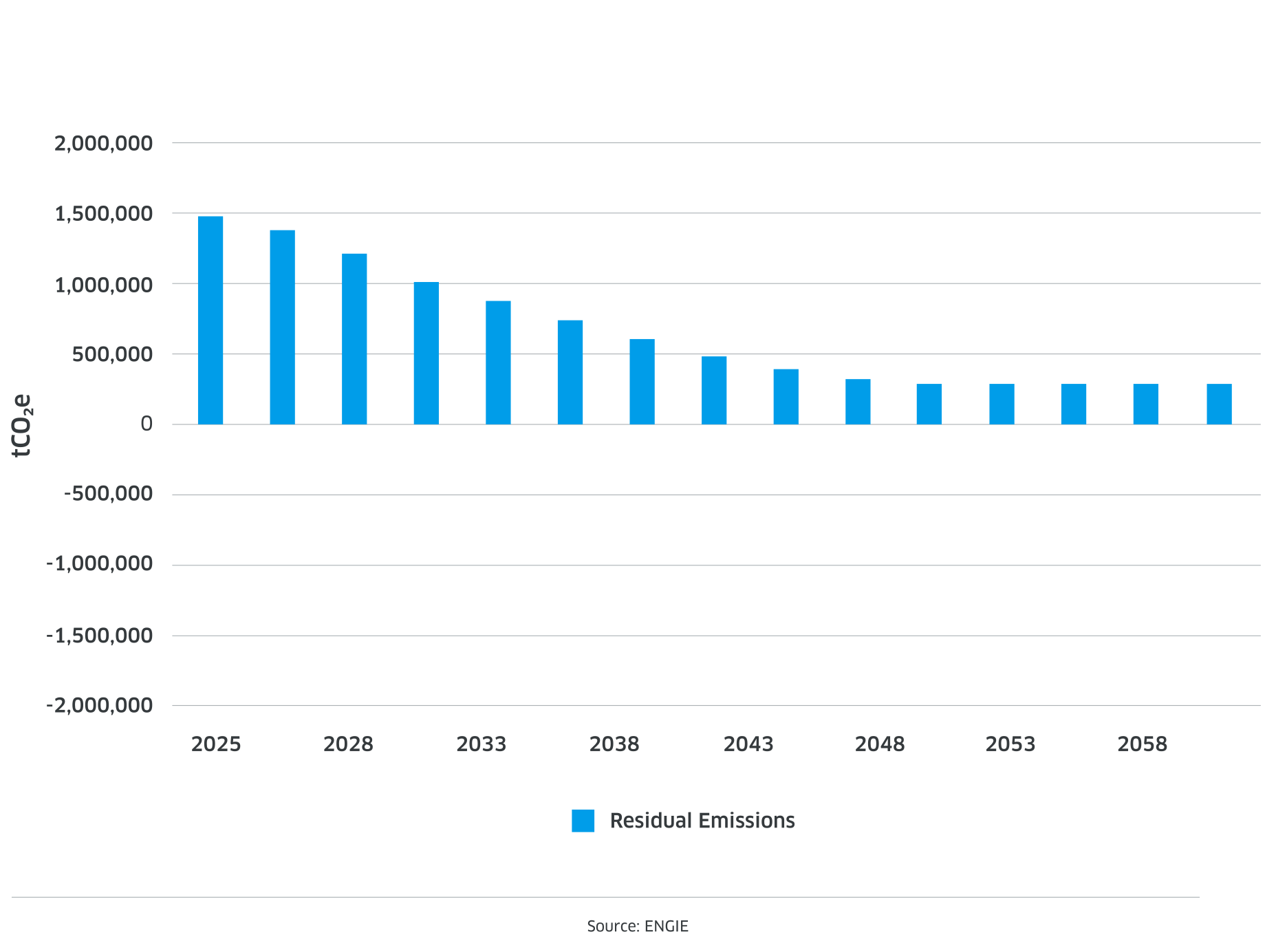
In this scenario, companies focus exclusively on reducing emissions through operational improvements and energy transition measures. Emissions decline steadily, but hard-to-abate emissions remain. By 2050, residual emissions still represent roughly 10% of the original footprint, leaving the company short of Net Zero.
While this pathway prioritizes internal action, it delays responsibility for unavoidable emissions and results in higher cumulative emissions over time.
Scenario 2: License to operate
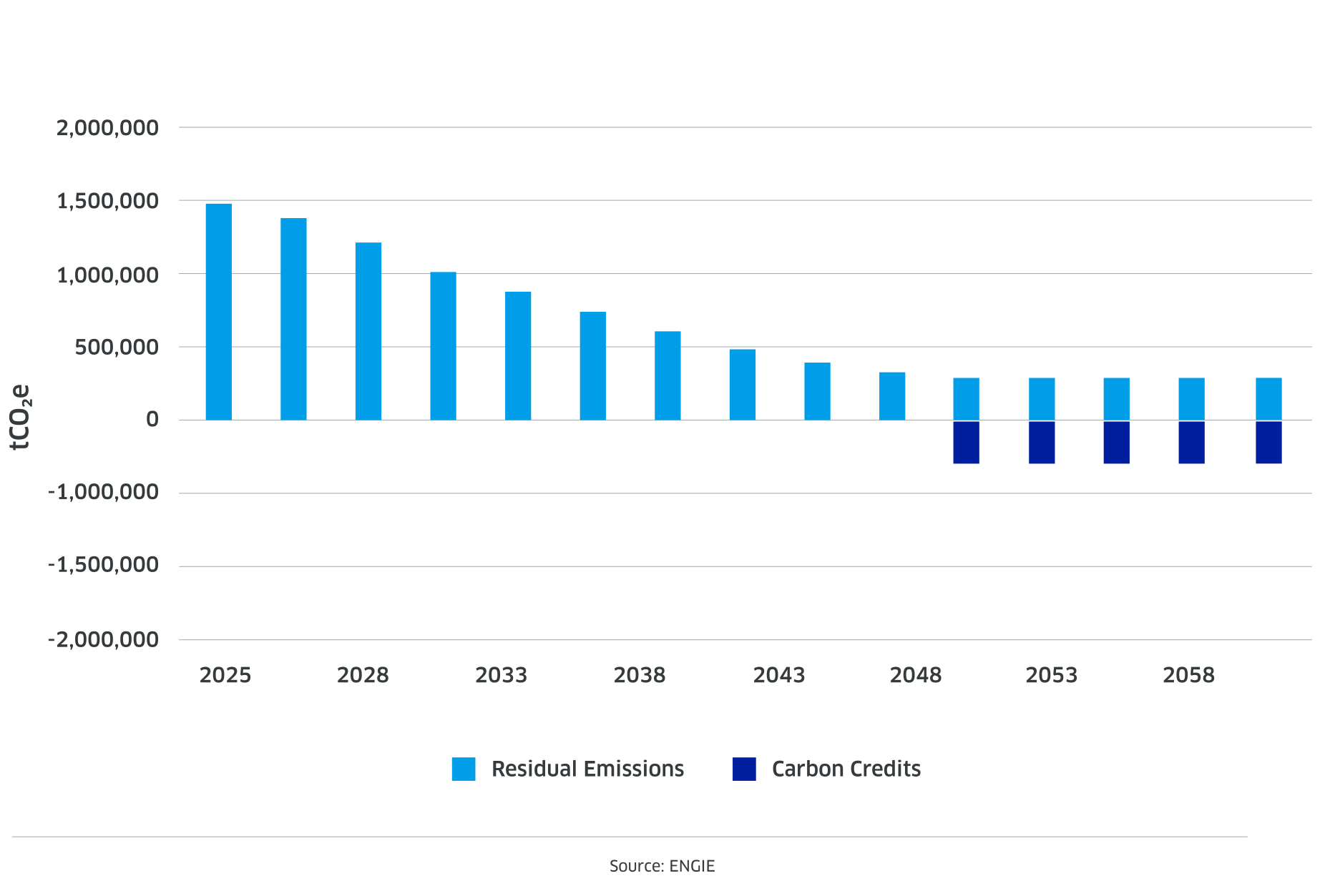
The second scenario reflects the original interpretation of the SBTi Corporate Net-Zero Standard: companies reduce emissions by 90–95% by 2050 and use high-quality carbon removals to neutralize residual emissions at the target date.
The SBTi framework has played a critical role in defining credible corporate climate action, setting a science-based benchmark for deep decarbonization. However, in its initial form, it effectively positioned carbon credits as an end-state solution — something to be used once emissions reductions were largely complete.
As a result, this pathway represents a minimum threshold for alignment rather than a model for climate leadership. While scientifically grounded, it concentrates action too late, missing the opportunity to reduce cumulative emissions during the critical decade.
Scenario 3: Early engagement
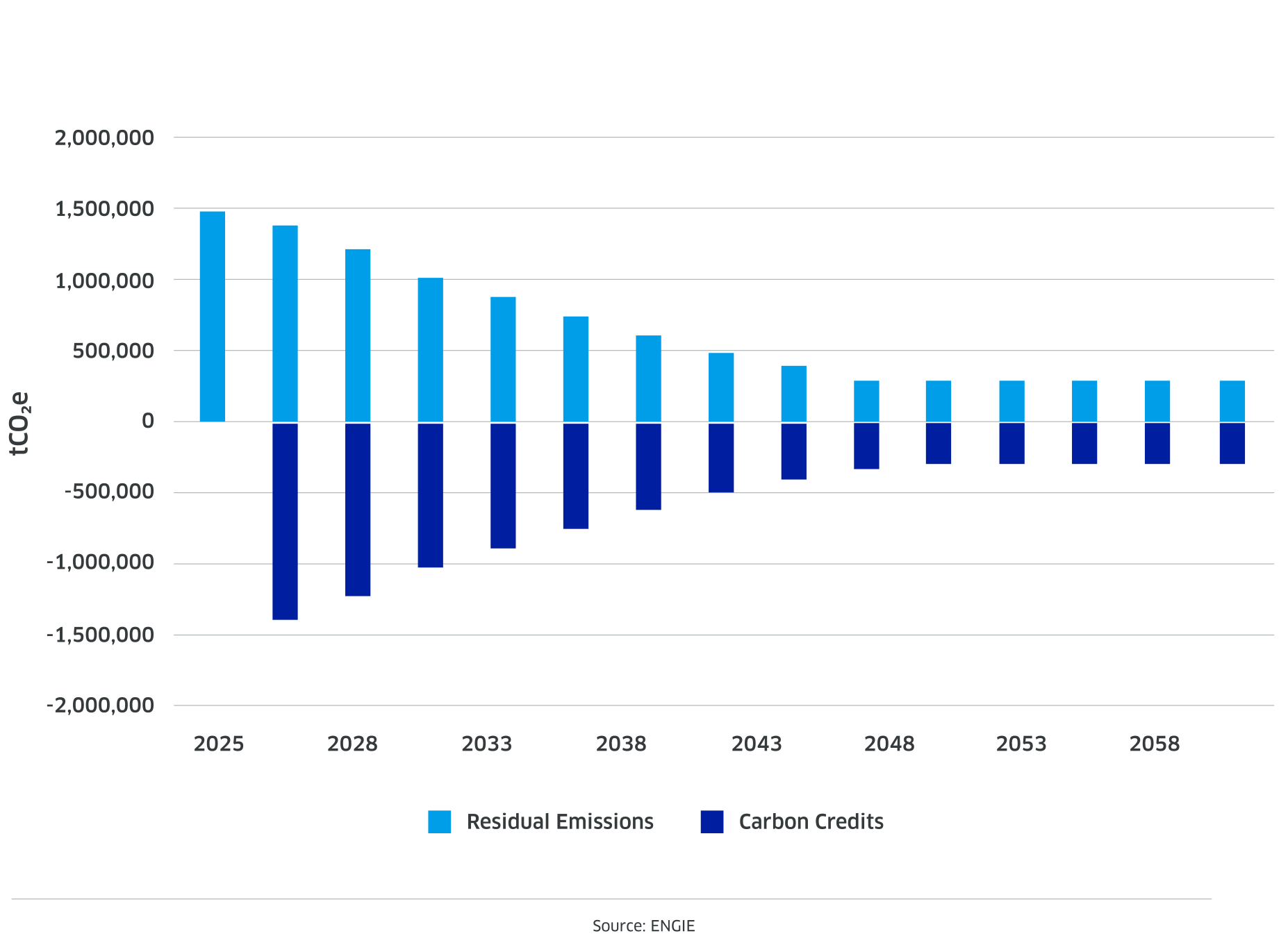
The third scenario combines ambitious decarbonization with early engagement in carbon markets. Rather than waiting until 2040 or 2050, companies address unavoidable emissions as they occur, while continuing to reduce their footprint in line with science-based pathways.
By purchasing high-quality carbon credits and entering long-term offtake agreements, companies take responsibility for their full emissions footprint today. At the same time, they help scale the carbon markets and project pipeline that the broader energy transition depends on.
In practice, this approach allows for a short preparation phase, followed by a gradual build-up of a diversified credit portfolio — combining spot purchases with long-term contracts. The result is a dramatic reduction in cumulative emissions, with total emissions potentially falling to less than two baseline years.
A converging standard: SBTi explores early engagement
The ongoing consultation on a potential SBTi Net‑Zero Standard Version 2 signals a potential direction of travel that would bring its logic closer to Scenario 3, while preserving its core requirement for deep emissions reductions.
The current draft Standard explores a role for early carbon credit use alongside long-term decarbonization pathways, while keeping such use separate from formal target achievement.
In this framing, the draft moves beyond a strictly end-state conception of credits and considers whether companies could take action on ongoing emissions during the transition — complementing, not replacing, deep decarbonization of their value chains.
This consultation reflects a broader discussion highlighted by SBTi itself: whether delaying action on residual emissions risks higher cumulative atmospheric impact, even when long-term targets are ultimately met. By exploring earlier engagement with high‑integrity credits, the draft raises the question of how companies might contribute to near‑term climate impact without compromising the integrity of science‑based targets.
Choosing the right partner
Navigating the voluntary carbon market in 2026 requires more than a procurement team and a budget. The market has become genuinely difficult to navigate — fragmented standards, opaque pricing, evolving methodologies, and a growing gap between marketing claims and on-the-ground reality. The right partner cuts through that complexity rather than adding to it.
What that looks like in practice: deep market expertise, stringent project due diligence — assessing carbon impact, governance, permanence, additionality, and community outcomes — and portfolios that are tailored to a specific emissions profile and evolve as decarbonization progresses. Critically, the partner should have skin in the game: applying the same net-zero principles to their own operations that they recommend to clients. That alignment is foundational to credit quality, claim integrity, and the long-term credibility of any strategy.
The companies that will lead on climate this decade are those that act now, securing high-integrity offtakes, building portfolios aligned to science-based pathways, and working with partners whose standards they can stand behind.