EU CRCF: The Integrity Problem Is (Mostly) Solved — Now Comes the Hard Part
The EU’s Carbon Removal and Carbon Farming regulation has done something genuinely difficult: it has built a credible supply-side standard. The harder question — what certified units can legitimately be used for — is still wide open.
-
par Nathalie Wijns - Article
- Publié le 01/04/2026

Authors: Tine Bax, Lucille Bombarde, Josh Brown, Alexis Manuel
When the European Union published the Carbon Removal and Carbon Farming Regulation (CRCF) in late 2024, it marked a milestone: the first legally grounded, EU-wide certification framework designed specifically for various carbon removal pathways. The framework covers direct air capture (DACCS), bioenergy with carbon capture and storage (BECCS), biochar, and a range of carbon farming practices, rigorously defining how removal units must be monitored, quantified, and verified.
For companies navigating the carbon markets, the arrival of CRCF represents a meaningful shift. It essentially amounts to the EU putting its stamp on what counts as a credible removal. But certification, it turns out, is only half the problem.
What the CRCF actually is

“The CRCF is fundamentally a monitoring, reporting, and certification framework. It’s not a market design, and it does not intend to create demand on its own.” – Tine Bax, ENGIE Senior EU Public Affairs Manager
The regulation establishes methodological rules for additionality, quantification, and permanence across different removal categories. It differentiates between permanent removal methodologies (DACCS, BECCS, biochar) and nature-based removals under the carbon farming pillar, whose sequestration benefits are shorter-lived.
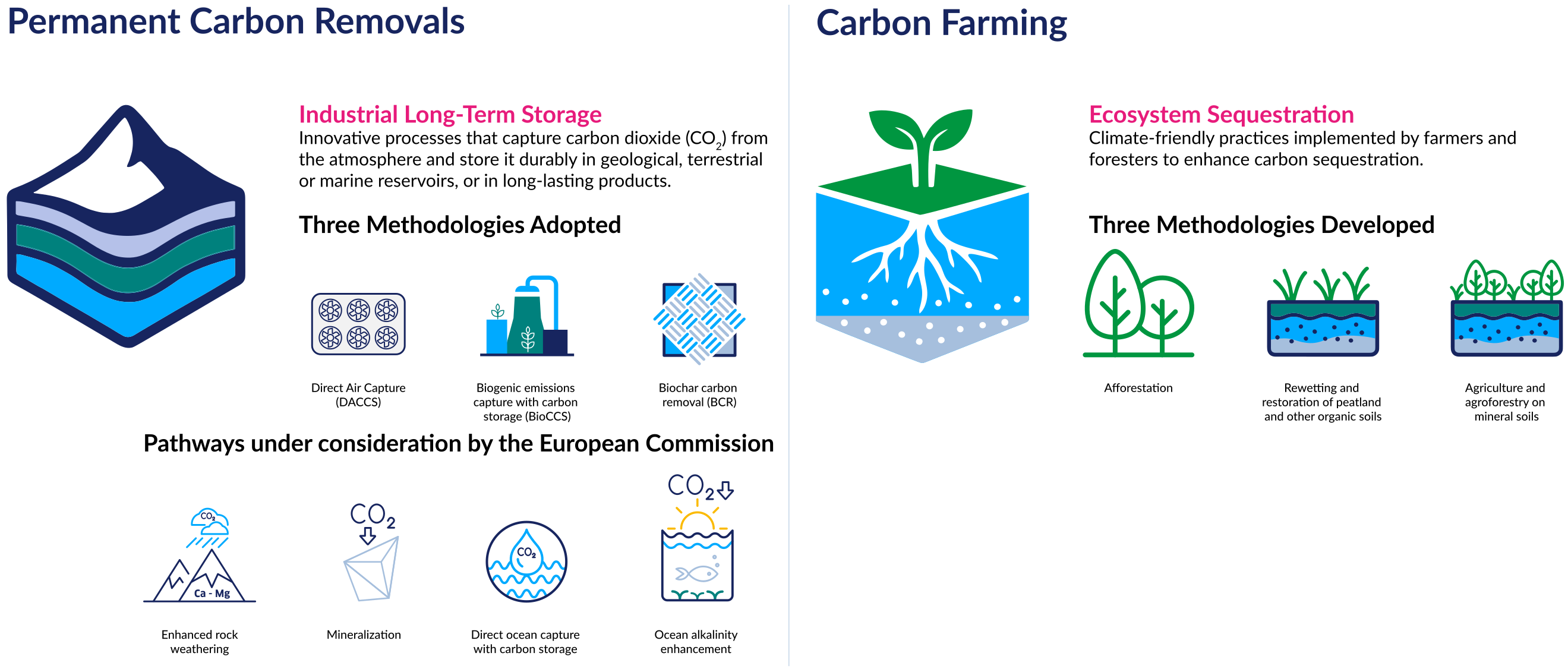
The first certification methodologies for DACCS, BECCS, and biochar have already been adopted by the European Commission. Additional methodologies for other technologies will follow, though their scope remains uncertain. According to EC officials, the first CRCF carbon farming methodologies are expected to be adopted by the end of April, after which they will be subject to a two-month scrutiny period by other EU institutions. The draft still lacks clarity at the level of individual practices.
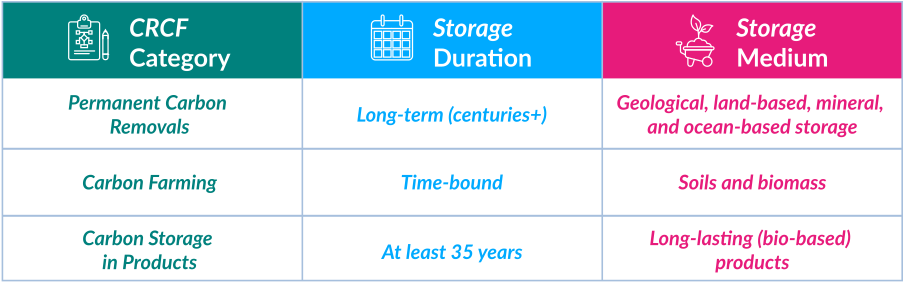
The framework is also explicitly European in scope: production and storage of removal units must occur within the European Economic Area — which includes the EU Member States as well as Iceland, Liechtenstein, and Norway. This has real operational implications.
“Because CRCF requires production and storage to happen within Europe and close to renewable energy sources, project economics can be more constrained than in global voluntary markets.” – Lucille Bombarde, Specialist & Project Engineer

A direct air capture facility in Saudi Arabia — where renewable electricity is cheap, abundant, and in close proximity to storage sites — would not qualify. As Bombarde explained, companies wishing to certify DACCS removals under the framework must locate their projects where renewable power is accessible within Europe — adding cost and limiting viable sites. Geological storage of captured CO2 adds a further challenge: Europe’s primary storage site is currently in Norway, meaning CO2 captured in France or Spain must be transported at additional cost and with leakage risk en route.
What it has resolved — and why that matters
Despite these constraints, the CRCF accomplishes something the voluntary carbon market (VCM) has long struggled with: a defensible, EU-sanctioned quality standard. For buyers facing reputational and increasingly legal exposure under evolving green claims rules — that matters.

“CRCF is a stamp from the EU saying this certification is good enough for Europe. In terms of quality, buyer confidence, and reputational risk, it’s probably the strongest guarantee you can have on a credit today.” – Alexis Manuel – Head of Carbon Desk
This is a significant benefit. The VCM has faced sustained credibility problems, with major standards under scrutiny and corporate net zero claims questioned by regulators and journalists alike. An EU certification regime with legal standing, third-party verification, and mandatory monitoring obligations provides a qualitatively different level of assurance.
On the supply side, the methodological architecture is broadly accepted, and the monitoring requirements, while demanding (e.g., the obligation to track geological CO2 storage for decades until responsibility transfers to national authorities), are understood as legitimate given the permanence claims being made.
The unresolved question: what can buyers actually claim?
The supply-side architecture is largely in place. What remains deeply uncertain is the demand side — specifically, what purchasing a CRCF-certified unit allows a company to say.
“Once you have a certified removal unit, the real question is: what can you do with it? That’s where a lot of uncertainty still exists.” – Tine Bax
Two distinct use cases are in play. The first is integration into the EU Emissions Trading System (EU ETS). The political groundwork here is more advanced than many appreciate. Following the EC’s proposal for the 2040 climate target, aiming to reduce emissions to 90% below 1990 levels, it has now been agreed in the EU Climate Law that domestic permanent removal units issued under the CRCF (technology-based removals) will be integrated into the EU ETS. Legislative proposals to this effect should form part of the upcoming ETS review scheduled for later this year (estimated in July). Contracts for difference, already under active discussion in the UK ETS, have also entered the conversation as a mechanism to bridge the cost gap between removal units and EU Allowance (EUA) prices.
The second use case — corporate climate claims — is considerably murkier. Companies considering CRCF-certified units for their net zero trajectories face a landscape of overlapping and still-evolving frameworks: Science Based Targets initiative (SBTi) guidance on the use of removals, CSRD reporting obligations, the now-paused EU Green Claims Directive, and various corporate net-zero standards. CRCF units appear likely to be eligible across most of these frameworks, but the specific accounting treatment, and the degree to which they can be used to support strong public claims, has not been definitively settled.
“I hear companies asking: should we buy removals now, or wait for the European standard? Is there a risk we buy twice if the rules change?” – Josh Brown, Carbon Credits Originator, ENGIE Global Markets

This is not merely a theoretical concern. Sustainability managers at companies with net-zero or 2040 targets, are making decisions now about whether to begin purchasing removals, and whether to prioritise CRCF-eligible units over existing VCM credits. With key questions around accounting and claims still unresolved, many are opting to stay close to developments, seeking informed guidance before committing capital in a rapidly evolving regulatory landscape.
The cost reality
Layered on top of the use-case uncertainty is a pricing problem that the CRCF does nothing to solve. Current production costs for technological removals range from approximately €120–180 per tonne for biochar, €200–300 for BECCS, and €400–600 for DACCS — well above current EUA prices and far from the €100 per tonne target the sector is aiming for. Nature-based removals under the carbon farming pillar are cheaper — currently in the €40–80 range — but are treated as a shorter-duration removal (<100 years).
At this point though, more than 90% of current purchases of tech removal credits are attributable to a single buyer, with the remainder concentrated among high-margin firms in sectors where the reputational and strategic premium for first-mover positioning justifies the cost.
“The business case depends on three things: EUA prices going up, carbon removal prices coming down, and government support in the form of contracts for difference. Until that happens, uptake will remain limited.” – Josh Brown
The proposed EU “Buyers’ Club” — a financing initiative intended to aggregate credit demand and enable private buyers to conclude offtake agreements with CRCF projects — is a step in this direction. A draft blueprint is scheduled to be published on May 21, but at this point there is no known legal deadline, adoption date, or obligation to participate. Its voluntary nature and the absence of clear incentive structures for participation raise genuine questions about whether it will achieve meaningful traction.
“The corporate incentive for both carbon removals and carbon farming is unclear. This is especially pronounced for carbon farming units, where there is still no pathway for fungibility within the EU ETS. Meanwhile, ideas like an EU Buyers’ Club remain vague, offering little clarity on the value they deliver or why companies should participate.” – Josh Brown
What this means for companies today
The CRCF has defined what a high-quality European removal looks like. It has not yet answered what that quality is worth, or what it licenses a buyer to claim.
Companies with hard-to-abate residual emissions operating in sectors covered by the ETS have the clearest eventual use case, and the strongest rationale to engage with early-stage supply. Post-2031 integration into the EU ETS is increasingly viewed as a realistic planning horizon.
For companies primarily focused on voluntary claims — net-zero targets, CSRD reporting, SBTi alignment — the calculus is more complex. CRCF certification provides a credible quality signal, and its certified units are likely to align with existing reporting frameworks. But the specific use cases, and in particular whether CRCF units will unlock the potential to make claims that go beyond existing voluntary standards, remain an open question.
While committing to large-scale carbon removal procurement in the absence of regulatory clarity carries risk, so does disengagement. Project pipelines remain limited, lead times are long, and access to high-quality certified removals in the 2028–2032 window is unlikely to be frictionless.
“CRCF is a first step — a necessary step — but it’s not sufficient. What’s still missing are stronger demand signals and, potentially, subsidies to make these credits competitive.” – Alexis Manuel
In practice, this creates a narrower path for buyers: not full commitment, but not passive waiting either. Companies are increasingly combining selective early engagement with close tracking of how CRCF units will be treated across compliance and reporting frameworks, positioning themselves to act without locking in assumptions that may not hold.
“If you really want to pull the market, you must be clear about where these units can be used and the value they create. Without that, incentives are missing.” – Tine Bax
The implication is clear. The constraint is no longer defining integrity and quality but translating them into recognized use cases. Until that link is established, the most effective buyers will be those who stay close to both project pipelines and policy developments—positioning themselves to act as soon as the rules, and the value of these units, become more certain.