COP30, Article 6, and the New Reality for Corporate Carbon Buyers
Insights from a conversation with Dr. Axel Michaelowa
-
by Jerome Glass - Article
- Publié le 12/12/2025


When negotiators arrived in Belém for COP30, most expected Article 6 to finally shift from rulemaking to implementation. After years of technical work and the positive outcome of COP29 in Baku, many assumed carbon market rules were settled and attention could turn toward forests, finance, and operational rollout of activities. Instead, Article 6 surged back to the center of the agenda, with conversations that will directly shape how corporate buyers source and value carbon credits in 2026 and beyond.
To unpack the implications, we sat down with Dr. Axel Michaelowa, a Senior Founding Partner at Perspectives Climate Group and one of the most respected experts on international carbon markets. Over the course of an hour, he walked us through what happened inside the negotiation rooms, why Article 6 became one of the most politically charged topics of the conference, and what it all means for companies preparing their carbon procurement strategies.
A COP That Returned to Negotiation Mode
Heading into COP30, negotiators expected only routine updates to Article 6.2 and 6.4. Instead, Article 6 became a major negotiation item, driven by three key issues.
The reversal-risk dispute under Article 6.4
In the run-up to COP30, a proposed “reversal risk” standard under the Article 6.4 mechanism (also referred to as Paris Agreement Crediting Mechanism – PACM) requiring forestry projects to be monitored indefinitely unless they could show negligible reversal risk, sparked renewed debate and was widely seen as unworkable by project developers. As Axel quipped, “100 years is longer than the lifetime of most private institutions.”
The PACM’s Supervisory Body ultimately deferred the issue to the methodology level but did not back down regarding the principle. The issue was thus postponed, confirming that integrity expectations under Article 6.4 will remain high and the market must adapt.
Article 6.2 Reopened Unexpectedly
Early technical reviews of countries’ initial Article 6.2 reports raised red flags, prompting a reopening of discussions of rules and interpretations—even for frontrunners like Switzerland and Japan. For corporate buyers, this signals a shift : under Article 6.2, quality varies significantly across countries and programs, and the UN’s scrutiny is increasing
Closure of the Clean Development Mechanism (CDM)
After years of debate, COP30 confirmed the CDM will close at the end of 2026, with its remaining US$27 million transferred as a loan to support early operations of the PACM until it is earning revenue from new credits.
For companies holding legacy CDM credits, this clarifies the end of the mechanism and underscores the urgency of understanding whether existing Certified Emission Reductions (CERs) can transition to Article 6.4.
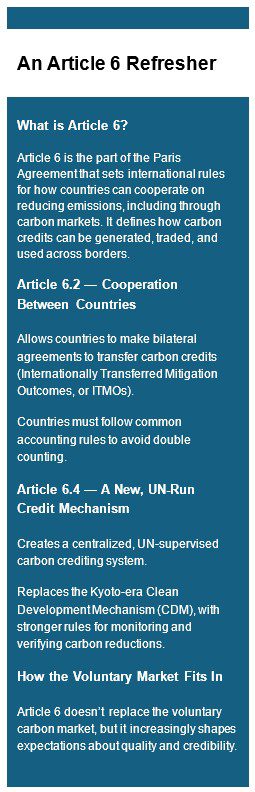
Together, these developments brought Article 6 back into sharp focus — not as a technical detail, but as an evolving system with direct market consequences.
While the first Article 6.4 credits are expected in early 2026, supply will remain limited until 2027, as new projects must complete the full process of registration, monitoring, verification, and issuance. Nonetheless, companies should be aware that Article 6.4 supply is coming, and when it arrives, it will reshape market benchmarks.
Companies Holding CDM Credits Should Act Now
Many corporate buyers still hold CERs from earlier climate strategies, but these legacy credits face a narrow transition window.
Only CDM projects that declared interest in transitioning by the end of 2023 are eligible, and host-country approval has been slow: out of roughly 1,500 projects and programs that applied, only about 100 have been approved so far. The deadline has been extended to June 30, 2026, but most new Article 6.4 methodologies won’t be ready until late 2026, creating a potential “credit gap”.
If you hold CDM credits, check whether the underlying projects declared interest by 2023, assess the likelihood of host-country approval, and confirm whether the project type has a credible path to approval under new Article 6.4 rules. Some credits may become stranded.
Integrity Drives Price : A New Market Hierarchy Is Emerging
On the emerging market hierarchy, Axel did not mince his words: “Once the first Article 6.4 credits come out, they will command a significant price premium compared to other credits—especially those from the voluntary market.” Article 6.4 embeds guardrails such as mandatory additionality, investment tests, and robust accounting, increasing both integrity and prices. Governments like Switzerland are already paying US$40–50 per unit for high-quality credits, far above typical voluntary market prices.

Axel expects the voluntary market to split into tiers: “gold-plated” credits aligned with Article 6.2 and authorized under rigorous national programs; “silver-plated” credits with partial alignment; and “ordinary” credits with no pathway to Article 6 alignment, growing oversupply, and heightened reputational risk. “We will see premiums steepen,” Axel said, “and oversupplied categories remain under pressure.”
Article 6.2: Buyer Beware
Axel’s strongest warning concerned Article 6.2 Internationally Transferred Mitigation Outcomes (ITMOs). “I would be extremely cautious,” he said. “There may be lemons, and at this point you don’t know what is a lemon and what is high quality.” He advises companies to watch for red flags, including:
- Unilateral authorizations issued before COP29 (Baku)
- ITMOs lacking robust measurement, reporting, and verification (MRV)
- Programs lacking transparency on additionality or baselines
- Opaque national authorization systems
Axel recommends piggybacking on Swiss or Japanese programs, which apply stricter standards and have clearer governance.
Integrity Will Improve — But Scrutiny Will Continue

Axel remains optimistic about Article 6.4’s guardrails: “In terms of additionality testing, we are now in the best world we’ve seen since the concept of international markets was conceived 30 years ago.”
Yet perfect integrity is unachievable. NGOs will continue to scrutinize methodologies, baselines, and permanence—especially for avoided deforestation and removals. The difference now is that Article 6.4 rules offer a clear, science-based foundation that should prevent the types of systemic failures seen in earlier markets. For corporates, this means integrity risks won’t disappear, but they’ll be more manageable, transparent, and priced-in.
Looking Ahead: What Buyers Should Watch in 2026
As our conversation wrapped up, we asked Axel what single message he’d offer corporate buyers preparing for the post-COP30 landscape. His answer: “Keep a close eye on which project types or methodologies get approved under the new Article 6.4 rules—and build your portfolio around them.” Approved methodologies will dictate which activity types remain commercially viable and which fall behind. For buyers, getting ahead of that curve will be essential.
The Bottom Line for Corporate Buyers
Across COP30 and our discussion with Axel, a clear picture emerges:
- Integrity expectations are rising — and prices with them. Article 6.4 credits will set a new benchmark.
- The voluntary market will continue to fragment. Knowing which tier a credit falls under will be key to managing both cost and reputational risk.
- Article 6.2 requires caution. Align with high-integrity programs and avoid standalone authorizations that lack transparency.
- CDM credits face a narrow, uncertain transition window. Review your holdings now.
- 2026 is a bridge year. Expect limited new supply until 2027.
- Methodologies are destiny. Approved activity types will shape the high-quality credit landscape.
For companies, the message is straightforward: understanding Article 6 is now central to managing carbon credit portfolios with confidence and strategic foresight.