SBTi’s Ongoing Emissions Responsibility
What It Means for Corporate Carbon Credit Procurement
-
by Jerome Glass - Article
- Publié le 12/12/2025


The Science Based Targets initiative (SBTi) is currently holding a public consultation on the second draft of its revised Corporate Net-Zero Standard (Version 2.0). This consultation was open until 12 December 2025, and the new standard is expected to be published in 2026.
Why a New Version? The updated Net-Zero Standard aims to provide a clearer, more actionable, and science-aligned framework for corporate climate action. Compared to Version 1.3, Version 2 introduces scope-specific target setting, a more flexible approach to Scope 3 emissions, and—crucially for carbon credit buyers—a new recognition mechanism for companies taking responsibility for their ongoing emissions.
What is Ongoing Emissions Responsibility (OER)? The OER framework is a new mechanism in the draft standard. It defines how companies can credibly and transparently take responsibility for the ongoing and residual emissions, including using carbon credits and other mitigation activities.
For corporate carbon credit buyers, this matters because the OER framework:
- Establishes clear pathways for voluntary and mandatory action on ongoing emissions.
- Clarifies the use of “ton-for-ton” (ex-post mitigation via carbon credits) and “money-for-ton” (carbon pricing and climate finance) approaches.
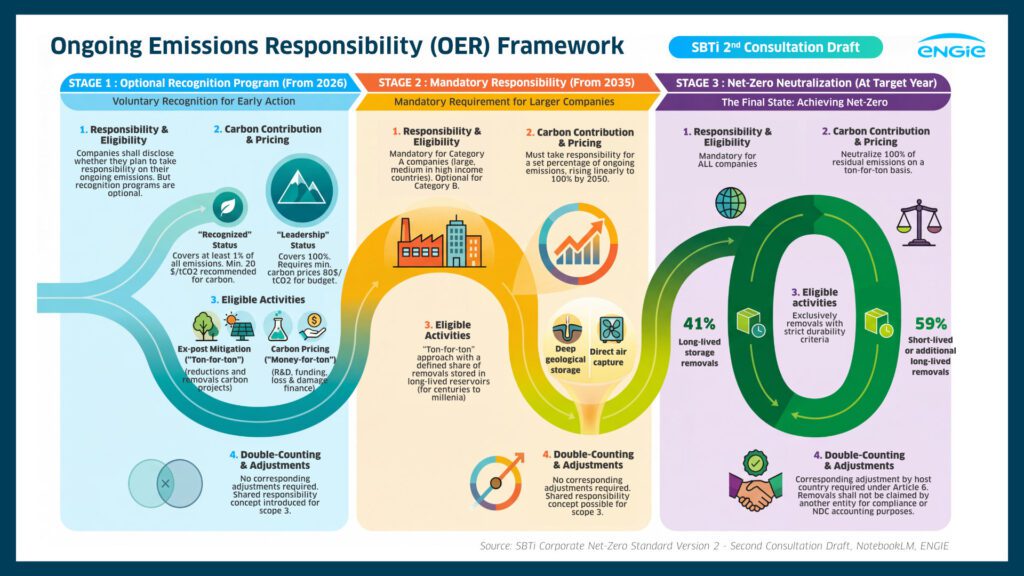
- Sets minimum thresholds for recognition (e.g., at least 1% of emissions for “Recognized” status, 100% for “Leadership” status), with increasing requirements over time.
- Clarifies how credits can be used, how double-counting is avoided, and what types of removals are eligible as companies approach net zero.
What to Expect from This Infographic? Our downloadable infographic provides a clear, visual summary of the phased OER framework as proposed in the SBTi’s second consultation draft. It illustrates:
- The three stages of OER: voluntary recognition (from 2026), mandatory responsibility for larger companies (from 2035), and full net-zero neutralization at the target year.
- The responsibility & eligibility for each stage, the contribution mechanisms, the eligible activities and the safeguards against double-counting.
If you would like to discuss what these changes mean for your organization—or explore how we can support you in navigating the evolving SBTi Net-Zero Standard—please contact our team. We’re here to help you understand the impact and seize the opportunities of credible, science-based climate action.