
Carbon Credits: Definition, Role and Use for Corporate Decarbonization
What are carbon credits?
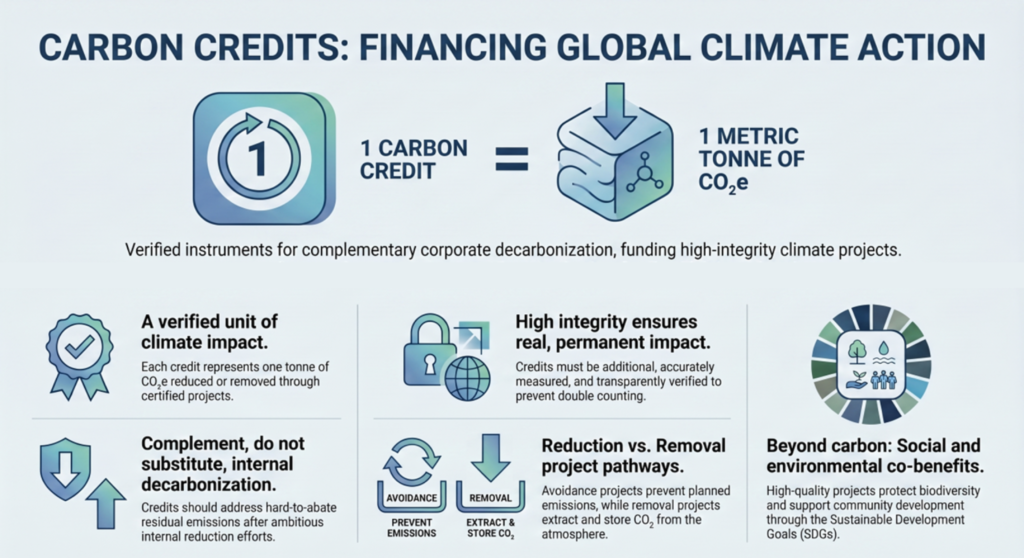
Carbon credits are verified instruments that represent the avoidance, reduction or removal of one metric tonne of CO₂ equivalent (tCO₂e) from the atmosphere through a certified climate project.
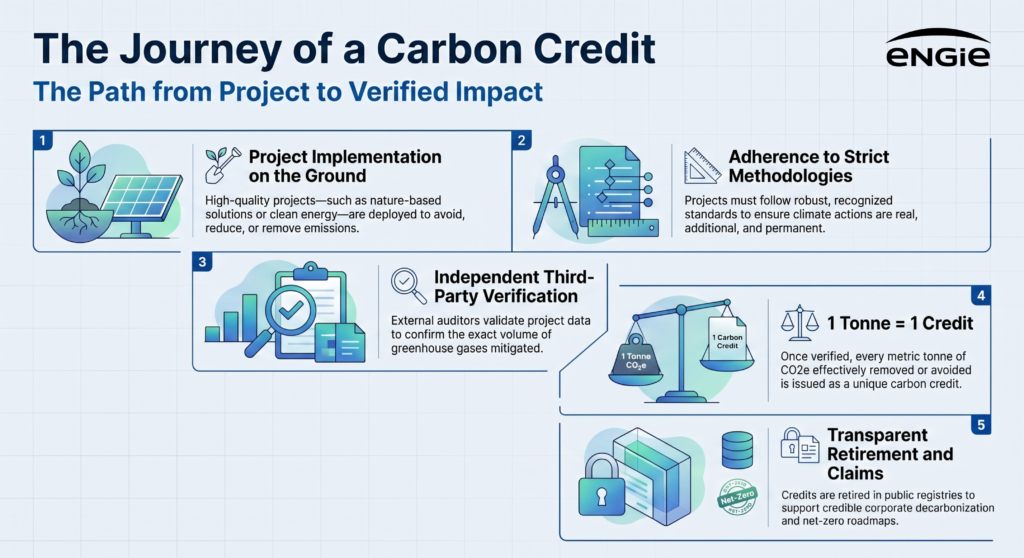
They are generated by high‑quality carbon projects implemented on the ground—such as nature‑based solutions or engineered carbon removal initiatives—and are issued following robust methodologies and third‑party verification under recognized standards.
Carbon credits help channel climate finance towards projects that deliver measurable climate impact while also generating environmental and social co‑benefits, including biodiversity protection and community development.
Why carbon credits matter in a corporate climate strategy
For corporates committed to climate action, carbon credits are not a substitute for decarbonization. They are a complementary solution that supports a broader, science‑aligned climate strategy.
Carbon credits can support companies to:
- Address hard‑to‑abate emissions that remain after ambitious reduction efforts.
- Accelerate climate action today, while long‑term decarbonization pathways are deployed.
- Support global climate projects that deliver verified impact beyond the company’s own value chain.
Used responsibly, carbon credits contribute to a credible and holistic roadmap towards net‑zero, in line with leading climate frameworks.
How are carbon credits generated?
Carbon credits are issued by certified carbon projects that follow strict development and verification processes. These projects typically fall into two main categories:
Emissions reduction and avoidance projects
These projects prevent or reduce greenhouse gas emissions that would otherwise occur, for example through ecosystem protection or improved land management practices.
Carbon removal projects
These projects remove CO₂ from the atmosphere and store it durably, either through nature‑based solutions or technological processes.
Each project is:
- Designed following an approved methodology.
- Independently validated and verified.
- Monitored over time to ensure the claimed climate impact is real, measurable and transparent.
How corporates use carbon credits
Corporates typically integrate carbon credits into their climate strategy to:
- Mitigate residual emissions after implementing internal reduction measures.
- Support climate projects aligned with their sustainability priorities, geography or value chain exposure.
- Demonstrate tangible climate action and contribution to global mitigation efforts.
In specific cases—such as addressing residual emissions at or beyond a net‑zero target date—carbon credits issued from carbon removal projects may be used to support neutralization claims, when aligned with recognized guidance.
ENGIE’s approach to carbon credits
At ENGIE, we provide carbon credits solutions designed to support corporates throughout their decarbonization journey.
Our approach is built on:
- Project quality and integrity: rigorous selection, due diligence and monitoring.
- Transparency: clear documentation, traceability and impact reporting.
- Tailored solutions: carbon credits aligned with each client’s strategy, sector and maturity.
- Positive impact on the ground: projects delivering climate, biodiversity and community co‑benefits.
We act as a long‑term partner, helping our clients navigate carbon credits with confidence and credibility.
Carbon credits and responsible climate claims
Carbon credits should always be used with care and clarity in climate‑related communication.
Best practice includes:
- Communicating transparently on what carbon credits are used for.
- Avoiding ambiguous or misleading claims.
- Clearly distinguishing between emissions reductions, mitigation contributions, and—where applicable—neutralization of residual emissions using carbon removals.
ENGIE supports its clients in aligning their use of carbon credits with emerging standards and guidance, helping them build trust with stakeholders.
Key takeaways
- Carbon credits represent verified climate impact delivered by certified projects.
- They complement, but do not replace, direct emissions reductions.
- When used responsibly, they enable immediate climate action and support projects with strong co‑benefits.
- ENGIE delivers credible, transparent and tailored carbon credits solutions for corporate buyers.
Frequently Asked Questions on Carbon Credits
What is the difference between carbon credits and carbon offsets?
Carbon credits are verified climate instruments that represent a quantified reduction, avoidance or removal of one tonne of CO₂ equivalent, generated by certified carbon projects.
They are multi‑purpose instruments, which can support different uses and claims depending on how a company integrates them into its climate strategy.
One common use of carbon credits is to mitigate the impact of real, ongoing emissions by supporting climate projects outside a company’s own operations. This specific use is often referred to as “offsetting”.
In practice:
- Companies primarily focus on reducing emissions within their own value chain (Scopes 1, 2 and 3).
- Carbon credits enable companies to act beyond their value chain, by supporting certified projects that deliver climate impact elsewhere in the world.
Using the term carbon credits helps reflect this broader role: supporting climate action beyond value‑chain reductions, while offsetting is just one possible application of these instruments within a responsible climate strategy.
Are carbon credits only about “compensating” emissions?
No. Carbon credits are not limited to compensation. They are primarily a way to finance climate action outside a company’s own operations, by supporting projects that deliver measurable climate benefits.
They are most effective when used as part of a broader climate strategy, alongside robust emissions reductions.
Are carbon credits regulated?
Carbon credits have historically been used primarily in the voluntary carbon market, where corporates choose to use them to support their climate strategies beyond regulatory requirements.
However, the landscape is evolving. Increasingly, connections are being created between carbon credits and regulated frameworks, including:
- Certain emissions trading schemes or carbon tax systems, which recognize the use of carbon credits as part of compliance mechanisms.
- Sectoral schemes, such as in aviation, where carbon credits are used to meet industry‑wide climate obligations.
- National climate strategies, where governments explore how carbon credits can contribute to achieving Nationally Determined Contributions (NDCs) under international climate commitments.
As a result, carbon credits sit at the intersection of voluntary action and regulatory ambition. While their use remains governed by strict standards and verification processes rather than direct regulation, their role in supporting corporate, sectoral and national climate targets is becoming increasingly relevant.
How do carbon credits differ from emissions allowances?
Emissions allowances and carbon credits are different instruments, but they are not incompatible and can play complementary roles in a climate strategy.
Emissions allowances are regulatory instruments used in compliance systems (such as emissions trading schemes). They grant the right to emit a certain quantity of greenhouse gases. Holding or purchasing an allowance does not eliminate emissions—it merely authorizes them under a regulatory cap.
Carbon credits, by contrast, represent real, verified climate impact achieved through certified projects that reduce, avoid or remove emissions elsewhere.
In practice:
Carbon credits enable organizations to mitigate the climate impact of the emissions that still occur, by supporting climate action beyond their own operations.
Emissions allowances regulate and price emissions within a capped system.
Can carbon credits deliver benefits beyond climate impact?
Yes. Many carbon projects deliver co‑benefits beyond emissions mitigation, such as:
- Biodiversity protection and ecosystem restoration
- Local economic development
- Community empowerment and social resilience
These impacts are an integral part of high‑quality project selection.
How do companies choose the right carbon credits?
Choosing carbon credits depends on a company’s climate objectives, sector, geography and maturity. Key considerations typically include:
- Project type and climate impact profile
- Environmental and social co‑benefits
- Transparency, documentation and traceability
A structured, expert‑led approach helps ensure alignment with corporate sustainability goals.
Is using carbon credits compatible with credible climate claims?
Yes, provided they are used responsibly and transparently. Credibility relies on:
- Clear prioritization of emissions reductions
- Transparent disclosure on the role of carbon credits
- Appropriate language when communicating climate action
This helps avoid confusion and strengthens stakeholder trust.
Why work with a carbon credits solutions provider?
The carbon credits market is complex and constantly evolving. It involves a wide diversity of project types, standards, methodologies, regulatory developments and quality considerations. Navigating this landscape and identifying the right projects for the right purpose requires deep expertise, long‑term experience and rigorous governance.
ENGIE has been active in carbon markets for more than 15 years and is itself committed to a net‑zero trajectory. This means we use carbon credits not only for our clients, but also as part of our own climate strategy, continuously strengthening our understanding of project quality, risk management and impact assessment.
This experience allows us to:
- Navigate a complex and fragmented market with confidence
- Select and structure high‑quality, credible carbon projects
- Anticipate evolving standards, guidance and regulatory bridges
Our ambition is for our clients to benefit directly from this expertise. By working with ENGIE, companies access more than carbon credits alone: they benefit from a comprehensive decarbonization toolkit, integrated into a long‑term climate journey, and supported by a reliable partner aligned with their ambitions and values.