Long associated with fertilisers, ammonia is now stepping into a new role. Low-carbon ammonia is emerging as an important molecule in the global energy transition, attracting growing interest as a low-carbon energy carrier. Its potential lies in its ability to help decarbonise some of the hardest sectors to transform, while also enabling the transport of hydrogen over long distances.
A molecule with unique energy properties
Ammonia (NH₃) is one of the most widely produced chemical compounds worldwide. Today, around 70% of global ammonia demand is linked to fertilisers, with the remainder used in industrial applications such as plastics, explosives and synthetic fibres.
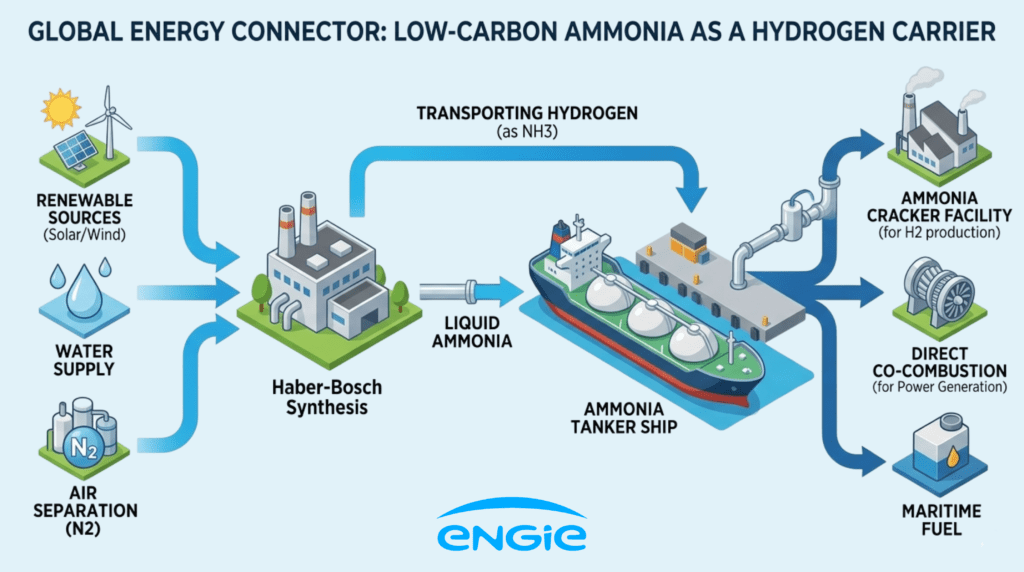
What is changing is not the molecule itself, but how it is being used. Beyond agriculture, ammonia has characteristics that make it increasingly relevant for energy applications. In liquid form, it is energy-dense and can often be stored and transported at scale more easily than pure hydrogen. For this reason, it is now considered a practical carrier for low-carbon hydrogen in international trade.
These properties make low-carbon ammonia particularly relevant for:
- decarbonising hard-to-abate industries such as steel, chemicals or refining
- transporting hydrogen across continents
- supporting some maritime and power applications
- contributing to the development of lower-carbon fuels for shipping
A fast growing global market
As industrial players look for credible decarbonisation pathways, the low-carbon ammonia market is gaining momentum. Its development is driven by industrial decarbonisation goals, climate policies and growing interest in low-carbon fuels.
In Europe, regulation plays a central role. RED III and the EU rules on renewable hydrogen help define sustainability criteria for hydrogen-based fuels, while FuelEU Maritime sets a clear decarbonisation trajectory for shipping. Under FuelEU Maritime, the greenhouse-gas intensity of energy used by ships calling at European ports must decrease from 2% in 2025 to 80% by 2050.
Together, these frameworks are shaping demand and positioning low-carbon ammonia as a strategic molecule in future energy systems.
How is low carbon ammonia produced?
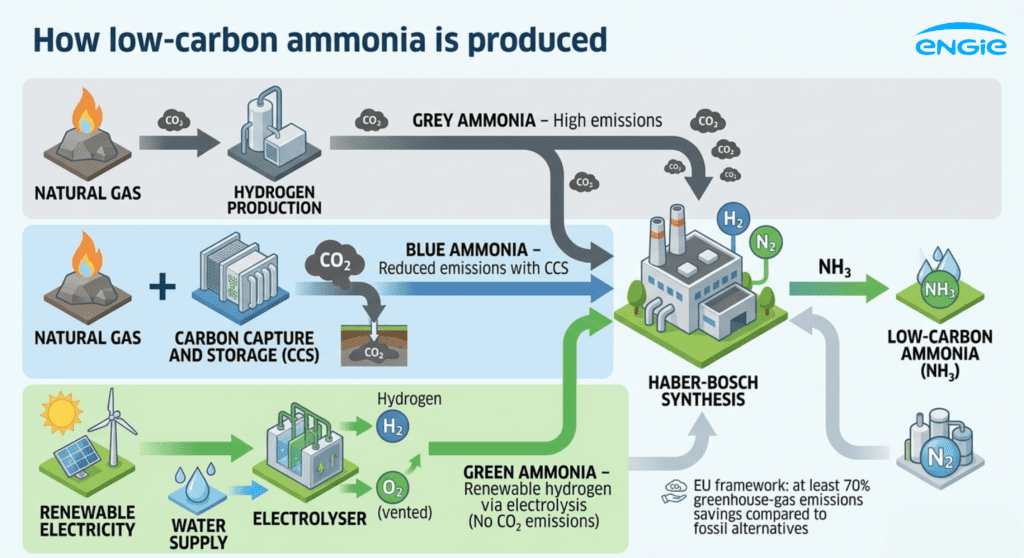
At the heart of ammonia production lies a well-established industrial process. Ammonia is produced through the Haber-Bosch process, which combines hydrogen (H₂) with nitrogen (N₂). Its carbon footprint therefore depends mainly on how the hydrogen is produced.
Grey ammonia is produced from fossil fuels without carbon capture and has a high emissions footprint.
Blue ammonia also relies on fossil-based hydrogen, but integrates carbon capture and storage (CCS) to reduce emissions.
Green ammonia is produced using hydrogen generated by electrolysis powered by renewable electricity.
Under the EU framework, renewable hydrogen and related fuels must achieve at least 70% greenhouse-gas emissions savings compared with fossil alternatives.
A key enabler of hard-to-abate decarbonization
By combining relatively mature industrial handling with the ability to carry hydrogen at scale, low-carbon ammonia offers a concrete option for sectors where direct electrification is not always feasible.
Its development nevertheless depends on several key conditions: access to low-carbon electricity, large-scale hydrogen production, infrastructure investment, certification systems and strict safety conditions. While ammonia has long been transported as cargo, its wider use as an energy fuel remains at an early stage.
As projects move forward and regulatory frameworks continue to mature, ammonia is expected to play an increasing role in the wider low-carbon hydrogen economy.
ENGIE’s contribution to the development of low carbon ammonia
As a global energy player committed to accelerating the transition to a carbon-neutral economy, ENGIE contributes to the development of low-carbon molecules through its expertise in renewable power, hydrogen, infrastructure and energy markets.
This approach is aligned with ENGIE’s ambition to develop 4 GW of hydrogen production capacities through electrolysis by 2035. By helping connect production, infrastructure and demand, ENGIE supports the emergence of scalable and certified low-carbon ammonia value chains.